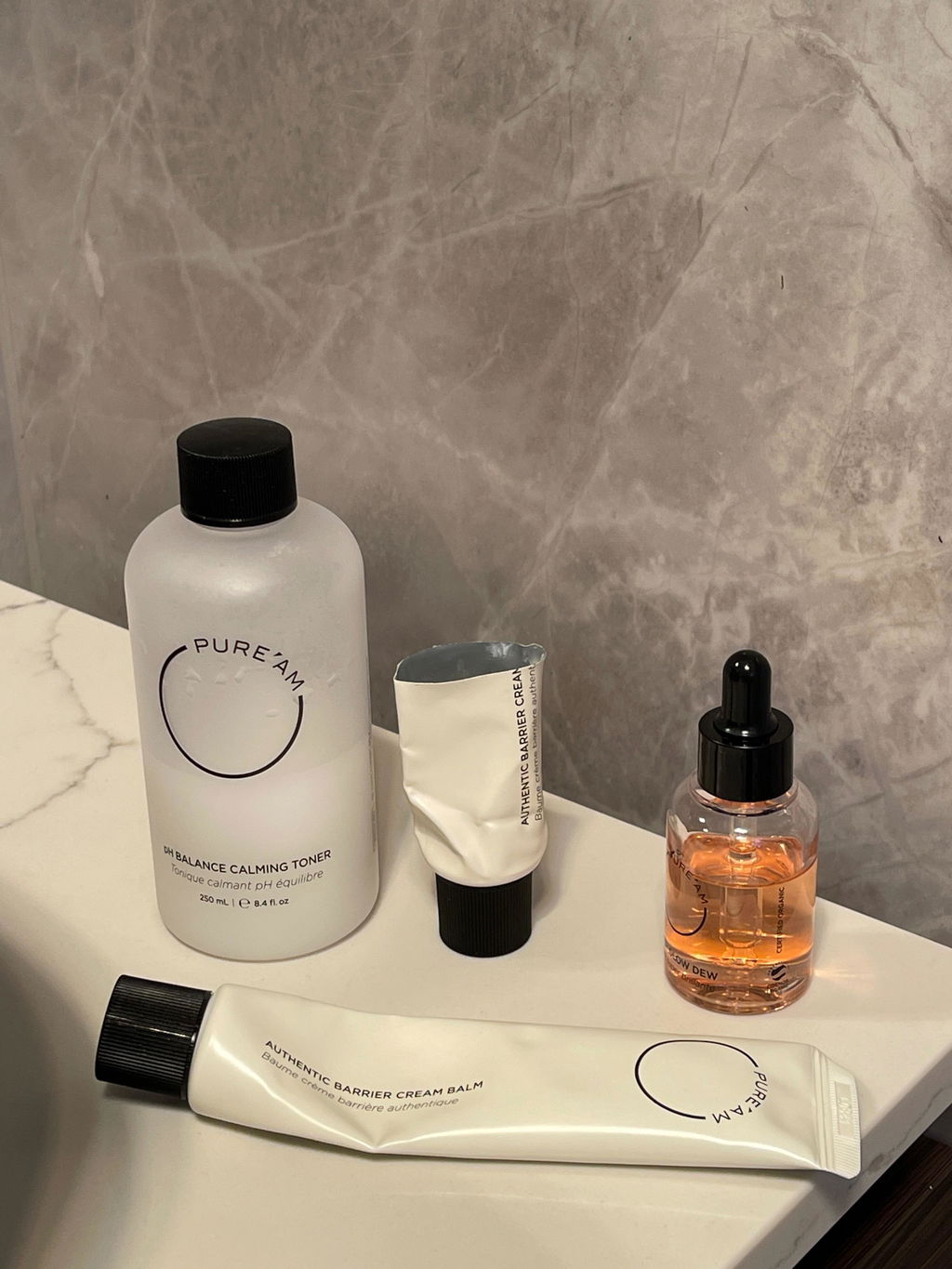
For gentle cleansing and barrier-focused moisture care, read organic labels, clinical tests and ingredient lists as answers to different questions. Organic content describes ingredient composition, while a product test supports only the outcome and conditions it evaluates. We apply these checks to our PURE'AM product pages below, looking at ingredient composition, test descriptions and product selection.
If you want a routine centered on gentle cleansing and barrier moisture rather than strong actives, start with what each claim actually establishes. Words such as organic, clinical and barrier care are useful only when their scope is clear.
Here is how to apply the same questions to our products and any other skincare page you are considering.
What does each skincare claim tell you?
| Claim or label | What it addresses | What it does not establish on its own | What to check |
|---|---|---|---|
| South Korean natural or organic cosmetic labeling | Ingredient-content criteria described in the Korean labeling guidance | Gentleness for your skin or barrier efficacy | Content statements, certification body and registration details |
| An asterisk beside an ingredient | A designation attached to that ingredient | The irritation potential of the whole formula | The footnote below the ingredient list |
| South Korean functional-cosmetic wording | The stated functional benefit | Unlisted benefits or the same result for everyone | The specific functional category and claim |
| Clinical or human-use testing | Results for a particular product under defined conditions | Results for another product, different skin or longer use | Tested product, study duration and measured outcome |
| Skin compatibility or irritation testing | Skin responses under the test conditions | Hydration or barrier improvement | The purpose and conditions of the test |
One label does not do another label’s job. Organic ingredient sourcing and evidence of a measured benefit answer different questions.
What does “organic cosmetic” mean in South Korea?
When shopping in the US, check which market a regulatory claim refers to. The Korean labeling discussion below concerns South Korea.
According to Newsis (2025), South Korea ended its government certification system for natural and organic cosmetics. The report explains that products meeting the Korea Cosmetic Association’s private guidance criteria, with substantiating documentation, can carry the relevant labeling and advertising without government certification.
The same Newsis report describes criteria based on ISO 16128 guidelines: natural cosmetics require at least 95% natural ingredient content, while organic cosmetics require at least 10% organic ingredient content and at least 95% natural ingredient content, including the organic portion. Products with private certification, such as COSMOS, can also communicate that certification with supporting documentation.
These are ingredient-composition criteria. When reading an organic claim, ask:
- What carries the designation? Distinguish the finished product from a specific ingredient.
- Who verified it? Look for the certification body and registration details.
- How is the proportion calculated? If a percentage matters to your decision, ask the brand to explain its calculation basis.
Is “barrier care” the same as a functional-cosmetic claim?
When reading Korean packaging or a Korean product page, look for an explicit functional-cosmetic designation and the benefit category attached to it. Read that wording within its stated scope, rather than extending it to other benefits.
If a page uses “barrier care” without a functional-cosmetic designation, treat it as a product description and examine the ingredient list and test information separately. The phrase alone is not a substitute for either.
For related Korean-market context, see Newsis (2022), on MFDS functional-cosmetics guidance, and Financial News (2024), on barrier-recovery functional cosmetics.
Whichever wording appears, persistent redness or itching is a reason to consult a dermatologist before simply switching products.
Applying the same questions to our products
AUTHENTIC BARRIER CREAM BALM: separate composition from test results
Our AUTHENTIC BARRIER CREAM BALM product page presents organic information and testing information separately:
- Organic scope: Certification markings appear beside selected ingredients. The page also states 20% organic and 100% natural composition. Read those proportions as composition information, not as proof of barrier performance.
- Whole formula: The ingredient list begins with Water. “Balm” does not mean the formula is water-free or that it cannot supply moisture.
- Testing: The page describes a transepidermal water loss (TEWL) test conducted by P&K Skin Research Center, with moisture-barrier-related results measured after two weeks of use.
The two-week test description should not be extended into a long-term outcome or a result for every skin type.
For your decision, keep the evidence separate: use the organic statements to understand ingredient composition and the test description to understand the measured outcome. The cream balm’s creamy texture, with butters and oils, is a separate consideration when choosing a moisturizer you want to use.
AMINO ACID MILD CLEANSER: mild does not mean acid-free
Our AMINO ACID MILD CLEANSER product page describes a mild, micro-foaming cleanser with a 100% vegan amino acid surfactant cleansing base. It also lists salicylic acid and Dandelion Postbiome Technology.
The important distinction is simple: “mild” does not mean “contains no acids.” If you are taking a break from exfoliating ingredients, the presence of salicylic acid matters to your selection. If you want cleansing alongside oil and exfoliation care, that ingredient may be relevant for a different reason. Neither decision should rest on the word “gentle” alone.
If you have been advised to avoid acids, choose according to that advice rather than assuming a mild cleanser qualifies. The full ingredient list remains part of the decision.
For related reading, our guide to post-cleansing tightness and reading cleanser ingredient lists is available in Korean.
How do cleansing and barrier moisture fit together?
Our cleanser directions recommend following cleansing with pH BALANCE CALMING TONER. Our cream balm directions place it after cleansing and toning. When you use those products together, the order is cleanser, toner, then cream balm.
| Product | Role | What to consider |
|---|---|---|
| AMINO ACID MILD CLEANSER | Cleansing | Whether a salicylic-acid-containing cleanser fits your current needs |
| pH BALANCE CALMING TONER | Post-cleansing hydration | Your skin’s needs and texture preferences |
| AUTHENTIC BARRIER CREAM BALM | Moisturizing and barrier care | Whether its creamy texture with butters and oils suits your preferences |
Every step is not mandatory at every use. Consider the role of each product before adding more steps; toner is a choice, not a condition that makes all moisturizers work.
Start with the claim that matters to your skin
Open a product page and separate its composition statements, ingredient details and test results. Then check whether those details answer your actual question, whether that is avoiding acids, choosing a texture or understanding a barrier claim.
To start with our formula, read the ingredient list and testing information side by side on the AUTHENTIC BARRIER CREAM BALM page. Choose the steps that fit your skin, with each claim kept in its proper scope.