Cleanser First: What to Use When Your Barrier Is Stressed
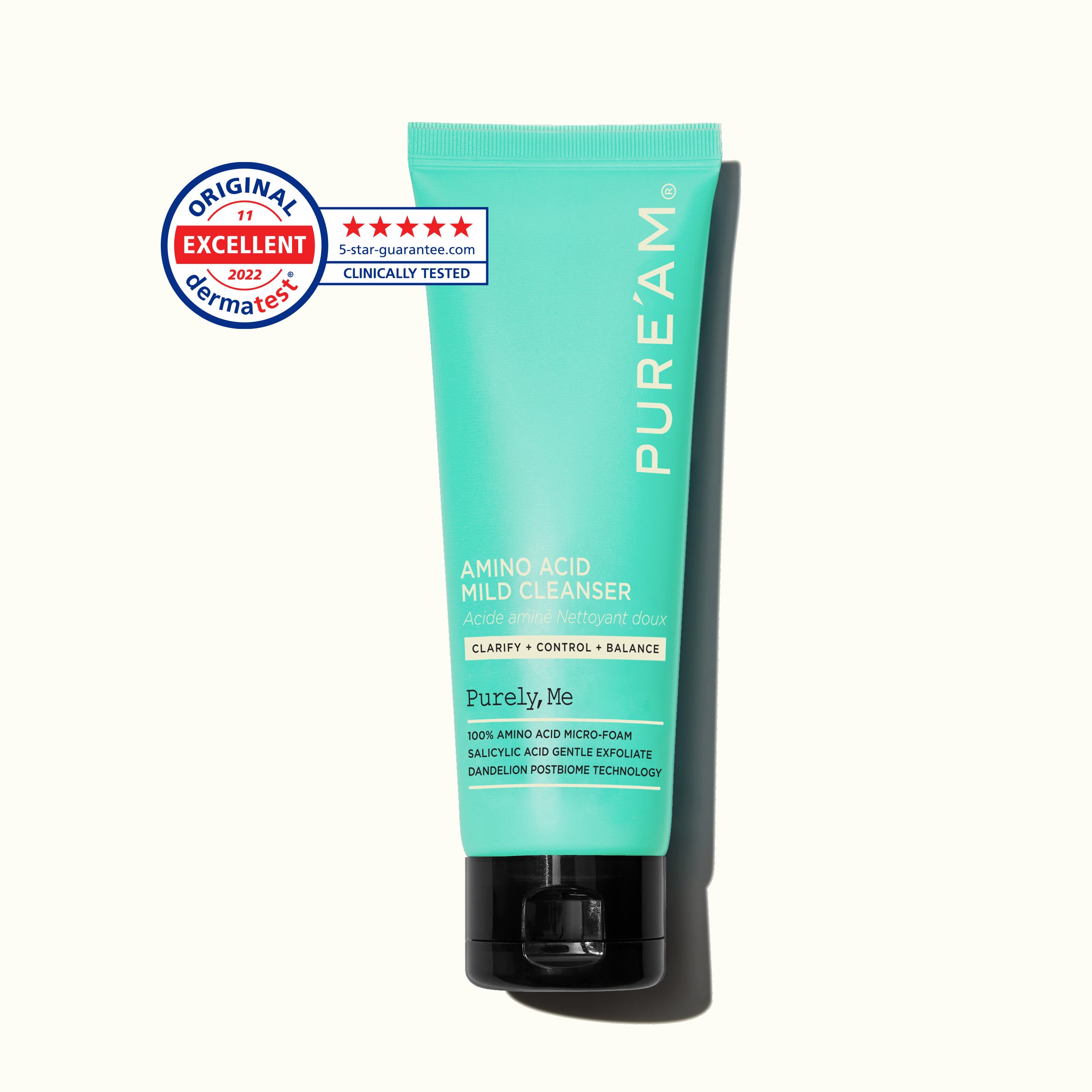
When skin feels irritated during a retinol or exfoliating-acid routine, review the cleanser's complete formula and washing method as well as the actives you leave on. An amino-acid-based cleanser is not automatically free of exfoliating ingredients: PURE'AM's AMINO ACID MILD CLEANSER contains salicylic acid. If your aim is to pause acids, check that distinction before choosing it, and discuss prescription changes or continuing irritation with your clinician.
The official AMINO ACID MILD CLEANSER page lists salicylic acid alongside amino-acid-derived cleansing ingredients. It is therefore not an actives-free or acid-free option for a routine that is deliberately pausing exfoliants. Assess that distinction alongside your current discomfort and the other products you use.
Why most "gentle K-beauty cleanser" lists don't actually solve this
Search "gentle K-beauty cleanser" and most lists hand you products that are gentle relative to a foaming sulfate bar, not gentle relative to a barrier that's already compromised. Two patterns show up repeatedly:
- Low-pH cleansers that still carry an active. Some of the most-recommended low-pH K-beauty cleansers are built around betaine salicylate or another BHA — useful for congestion, but still an active ingredient landing on skin that's already stressed from retinol or AHAs. Cupidrop's own pH guide points people toward exactly this kind of low-pH-but-active formula when the ask is really just "stop the stripping."
- Sulfate-based foaming cleansers marketed as "deep clean." Traditional cleansers frequently rely on sodium lauryl sulfate (SLS) or similar sulfates, which compromise the integrity of the skin barrier by disrupting the stratum corneum and increasing TEWL. That's the opposite of what a retinol- or AHA-stressed barrier needs.
Neither pattern is "bad skincare" in isolation. The problem is sequencing: recommending an active-adjacent or barrier-disrupting cleanser as the transition step away from actives skips the one thing that transition actually requires — a cleanse that adds zero additional stress while the barrier does its own repair work.
What amino acid surfactant chemistry actually changes
Amino acid surfactants are a distinct chemistry from both soap-based and sulfate-based systems. In a true amino acid formula, the core surfactants carry an "-oyl glutamate" or "-oyl glycinate" suffix — Sodium Cocoyl Glutamate is a common one, typically derived from coconut, and is known for being extremely gentle while still producing a creamy lather. That naming convention is a useful label-reading shortcut: if a cleanser's active surfactant doesn't end in -oyl glutamate, -oyl glycinate, or a similar amino-acid-derived name, it's a different (and often harsher) chemistry regardless of how the marketing describes it.
Two mechanisms explain why this matters for a stressed barrier:
pH proximity to skin's own chemistry. Amino acid surfactants are typically formulated in the mildly acidic pH 5.5–6.5 range, close to the skin's natural surface pH, which aprepre.com describes as leaving virtually no recovery window after cleansing — the barrier stays closer to its resting state instead of swinging alkaline and back. This isn't unique to amino acid chemistry alone; the underlying pH mechanism was documented by Ananthapadmanabhan et al., who found that high-pH (pH 10) solutions increase stratum corneum swelling and alter lipid rigidity even without any surfactant present, and that cleansers closer to the skin's normal pH of 5.5 are less likely to compound that swelling.
Minimal lipid extraction. The same NIH-published study found that gentle synthetic surfactants that minimally disrupt the skin barrier are best suited for individuals with dry or sensitive skin, in contrast to harsh anionic surfactants that pull ceramides and cholesterol out of the stratum corneum along with dirt and oil.
The recovery-time math most cleanser lists skip
Here's the part that's specific to this situation — switching off actives — rather than gentle cleansing in general. Sulfate-based cleansers strip protective lipids, and for sensitive or eczema-prone skin, that lipid layer can take 24–48 hours to rebuild. A barrier that's already thinned from retinol or daily AHA use doesn't get that 24–48 hours if it's re-stripped every morning and night. Each cleanse effectively resets the repair clock before it finishes.
Retinoids compound this on their own terms: they temporarily disrupt the skin's lipid barrier and increase TEWL as part of accelerating cell turnover, and stacking multiple actives — retinol, vitamin C, AHAs, BHAs — without adequate support between them overwhelms the skin's tolerance threshold. If you're deliberately stepping back from that stack, the cleanser is the one product you use twice a day, every day, regardless of what else is in rotation — which makes it the highest-leverage place to remove stress rather than add it.
Where amino acid cleansing fits in a transition routine
| What to check | How to assess it |
|---|---|
| Finished-product pH | Use product information rather than assuming a value from the surfactant class. |
| Exfoliating ingredients | An amino-acid-based cleanser may also contain salicylic acid. |
| Directions and skin response | Consider water temperature, friction, frequency, and other products in use. |
Check the finished ingredient list and directions; the surfactant family alone does not establish whether exfoliating ingredients are present.
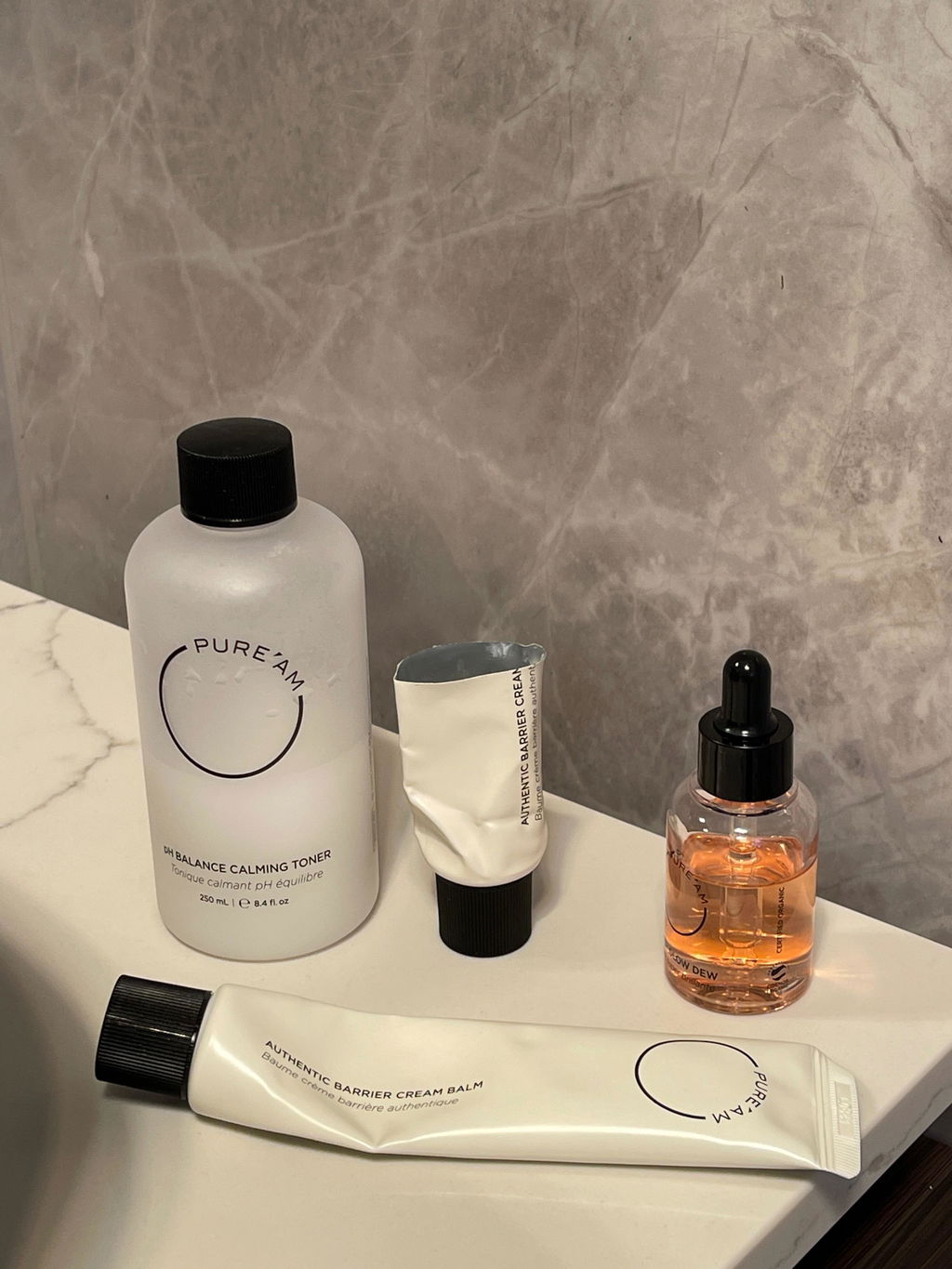
Cleansing alone doesn't finish the job, though. Even a gentle, pH-matched cleanser can leave skin's surface pH slightly altered afterward, which is why a balancing toner immediately after cleansing helps restore that pH and prepares skin to absorb what comes next. In our own routine sequencing, that's the role our pH BALANCE CALMING TONER plays directly after this cleanser — not as a treatment step, but as the bridge that closes the gap the cleanse can leave open. We walk through that full cleanser-to-cream sequence in how we build a PURE'AM routine for sensitive skin.
What this cleanser doesn't do
It's worth being direct about the limits. An amino acid cleanser doesn't repair a barrier by itself — repair depends on what you put back afterward (ceramides, fatty acids, occlusives) and how long you give the skin between active exposures. It also isn't a substitute for reintroducing retinol or acids more slowly once the barrier has actually recovered; a mild cleanser removes one stressor, not all of them. And amino acid surfactants generally lather less than sulfates, which some users read as "not cleaning enough" — for skin that's already reactive, that lighter lather is the point, not a shortcoming.
FAQ
Is an amino acid cleanser strong enough to remove sunscreen and SPF?
Amino acid surfactants clean effectively at their intended pH range, though very heavy, waterproof SPF formulas may need a preceding balm or oil step for full removal — the concern isn't cleansing power so much as whether a single amino-acid wash breaks down thick, silicone-based sunscreen film. For daily-wear SPF and normal makeup, one wash is typically sufficient without a double cleanse.
How long should I use a barrier-support cleanser before reintroducing retinol or AHAs?
There's no universal timeline verified across all skin types, and dermatologist guidance generally ties reintroduction to symptom resolution (reduced tightness, redness, and flaking) rather than a fixed number of days. Watching how skin responds to a gentle cleanser and moisturizer for at least a couple of weeks before slowly reintroducing actives is a more reliable signal than a calendar date.
Can I use an amino acid cleanser every day, or only during a "recovery" period?
Amino acid surfactants are formulated to be mild enough for twice-daily use precisely because they're close to skin's natural pH, which is why they work as a long-term daily step rather than only a temporary recovery product. Many people who switch off harsher cleansers for barrier reasons simply stay on the gentler formula rather than reverting once the immediate irritation resolves.
Does a low pH alone make a cleanser safe for a stressed barrier?
No — pH is one variable, not the whole picture. A low-pH cleanser that still contains an active exfoliant (a BHA or AHA) is gentler on the surfactant side but still adds chemical exfoliation, which is the opposite of what a retinol- or acid-stressed barrier needs. Check both the pH and whether the ingredient list contains an active, not just one or the other.
What should I use right after cleansing if my skin still feels tight?
Persistent tightness after a gentle, correctly-formulated cleanse usually points to what comes next in the routine rather than the cleanser itself — a pH-balancing toner followed by a barrier-supportive moisturizer is the more common next step than switching cleansers again.
Ready to simplify the front end of your routine? Start with the Amino Acid Mild Cleanser, and see how the full sequence fits together in our sensitive-skin routine guide.