TL;DR: "Contains a certified organic ingredient" and "certified organic product" are two different claims: COSMOS certifies raw materials separately from finished formulas, and only the product-level COSMOS ORGANIC or COSMOS NATURAL signature covers the whole formula. A cosmetic can legitimately say "organic" while sitting at 10 to 20 percent organic content, because water dilutes the math and isn't itself organic. That split says nothing about whether a formula suits reactive skin; that comes down to the surfactants, preservatives, and fragrance load in the finished formula.
A toner that lists "organic chamomile extract" and a serum that carries a COSMOS ORGANIC seal on its box are making different claims, even if both say "organic" somewhere on the label. Reading the fine print behind that word changes what you're actually buying, and for skin that reacts easily, that fine print matters more than the word itself.
Ingredient certification and product certification are graded on different things
COSMOS, the standard behind most "organic" claims on Korean and European skincare, runs two separate certification tracks:
- Ingredient-level: COSMOS APPROVED or COSMOS CERTIFIED. The thing being reviewed is a single raw material, such as an extract or an oil. Buying that ingredient and adding it to a formula does not carry the certification over to the finished product.
- Product-level: COSMOS ORGANIC or COSMOS NATURAL. The thing being reviewed is the entire finished formula: ingredient sourcing, organic content ratio, manufacturing, and packaging all have to clear the standard together.
That is why "contains COSMOS-certified organic yuzu extract" can be a true statement about one ingredient without making the finished toner a "COSMOS-certified cosmetic." The signature's placement on the packaging tells you which claim you're reading: next to the ingredient name, or next to the product name. COSMOS documents both signatures explicitly, and in Korea, testing bodies such as KTR run the product-level review as a separate procedure from ingredient certification.
The product-level number is more specific than "contains organic"
COSMOS ORGANIC is a graduated label with specific percentage thresholds attached. Soil Association's certification guidance sets two thresholds that a finished product has to clear at the same time:
| Requirement | Leave-on products | Rinse-off products |
|---|---|---|
| Physically processed agro-ingredients that must be organic | 95%+ | 95%+ |
| Total formula that must be organic | 20%+ | 10%+ |
A cleanser or shampoo gets the lower 10% floor; a serum or cream that stays on the skin needs to clear 20%. COSMOS NATURAL, by contrast, has no minimum organic percentage at all: it requires the formula to meet the standard's natural-origin and processing rules, but a product can carry that signature without any organic content. Two products wearing what looks like the same green COSMOS mark can be certified for entirely different things depending on which word follows it.
What a "10% organic" figure on a water-based formula actually reflects
Seeing a 10% organic figure on the label can read as unambitious. The reason the number looks small has almost nothing to do with how much the brand cared, and almost everything to do with water.
Skincare formulas, especially toners and cleansers, are often mostly water, and water cannot be grown organically, so it is excluded from the organic-content calculation entirely. The organic percentage of a raw material is measured against the non-water portion of the formula, then that figure gets recalculated against the full formula including water, which is what shrinks the number you see on the label. ISO 16128, the international guideline for calculating natural and organic content indices, treats water as fully "natural" for the purposes of a natural-origin index, which is a different measurement than the organic-content index COSMOS uses. A water-heavy formula can post a high natural index while its organic index stays modest, and the two numbers are answering different questions.
Put plainly: a 10% organic figure on a water-based toner usually means a substantial share of the non-water ingredients were organic, not that only one-tenth of the formula received any attention. A "99% natural" claim on the same shelf can be the less informative number of the two, since natural-origin thresholds are easier to clear in a water-based formula than organic-content thresholds are.
Korea moved the proof burden from a government mark to the brand
One regulatory shift is worth knowing if you're reading Korean labels specifically. South Korea's Ministry of Food and Drug Safety repealed its government-run certification system for natural and organic cosmetics, effective August 1, 2025, moving toward the market-driven certification model already used internationally, where bodies like COSMOS, not a government agency, review products.
A government seal disappearing shifts the burden of proof onto the brand rather than removing it. Brands can still label and advertise a product as "natural cosmetic" or "organic cosmetic" in Korea, but only when they hold documented evidence that it meets the underlying composition standards, since ISO 16128 itself is a calculation method rather than a certifying body. A brand citing "ISO 16128 natural index: 98%" is reporting a number it calculated under a defined formula, not announcing that a third party audited and passed the product. That distinction did not matter as much when a single government mark answered the question for consumers. Now, the calculation behind the number and who is willing to disclose it both carry more weight than the word "organic" printed on the front of the bottle.
Organic sourcing is not an irritation test
For reactive or easily irritated skin, this is the part that matters more than any certification tier. Organic farming standards govern how an ingredient is grown, harvested, and processed. They say nothing about how that ingredient behaves on skin that reacts easily, because certification bodies are not running patch tests on human skin as part of the review.
Fragrance is where this gap shows up most. Essential oils and plant extracts are common carriers of the compounds most likely to trigger a reaction, and regulators treat them accordingly regardless of organic status. In the EU, Commission Regulation (EU) 2023/1545 expanded the list of fragrance allergens that must be individually named on the label from 24 to roughly 80 substances, once concentration passes 0.001% in leave-on products or 0.01% in rinse-off products, with new products required to comply by July 31, 2026 and existing stock given until July 31, 2028. Korea runs a comparable system: cosmetics sold there must individually name any of 25 designated fragrance allergens once concentrations clear the same 0.001%/0.01% thresholds. A longer allergen list on a European label after mid-2026 usually signals disclosure catching up with an existing formula rather than a formula that suddenly became more complex.
For someone with reactive skin, the practical takeaway is to read past the certification logo to the ingredient list itself before checking anything else. If names like linalool, limonene, or citronellol appear repeatedly, that formula carries a noticeable fragrance load worth weighing on its own terms, independent of whether it's organic. The American Academy of Dermatology recommends patch-testing any new product on a small area of skin for several days before working it into a full routine, which stays true whether the product is certified organic, certified natural, or neither.
Four checks before you trust an "organic" label
- Where does the logo sit? A certification mark next to an ingredient name is an ingredient claim. The same mark next to the product name on the front of the package is a product-level claim, and the two are reviewed under different criteria.
- Is there a percentage attached? A labeled organic-content figure, and whether it's calculated against the whole formula including water, gives you something to compare. A bare "organic" adjective with no number gives you nothing to check.
- How does the featured ingredient relate to the rest of the formula? One organic extract near the top of a marketing headline doesn't describe the surfactants, preservative system, or fragrance further down the ingredient list, and those are usually where irritation risk actually lives.
- How long is the fragrance allergen list? Scan the end of the ingredient list for named allergens. That's a more direct signal for reactive skin than any certification tier.
The third check matters most for sensitive skin specifically. Skin doesn't come into contact with one highlighted ingredient in isolation; it meets the entire formula at once, and irritation more often traces back to the cleansing agents or preservative system than to whatever's in the hero callout.
How we approach this at PURE'AM
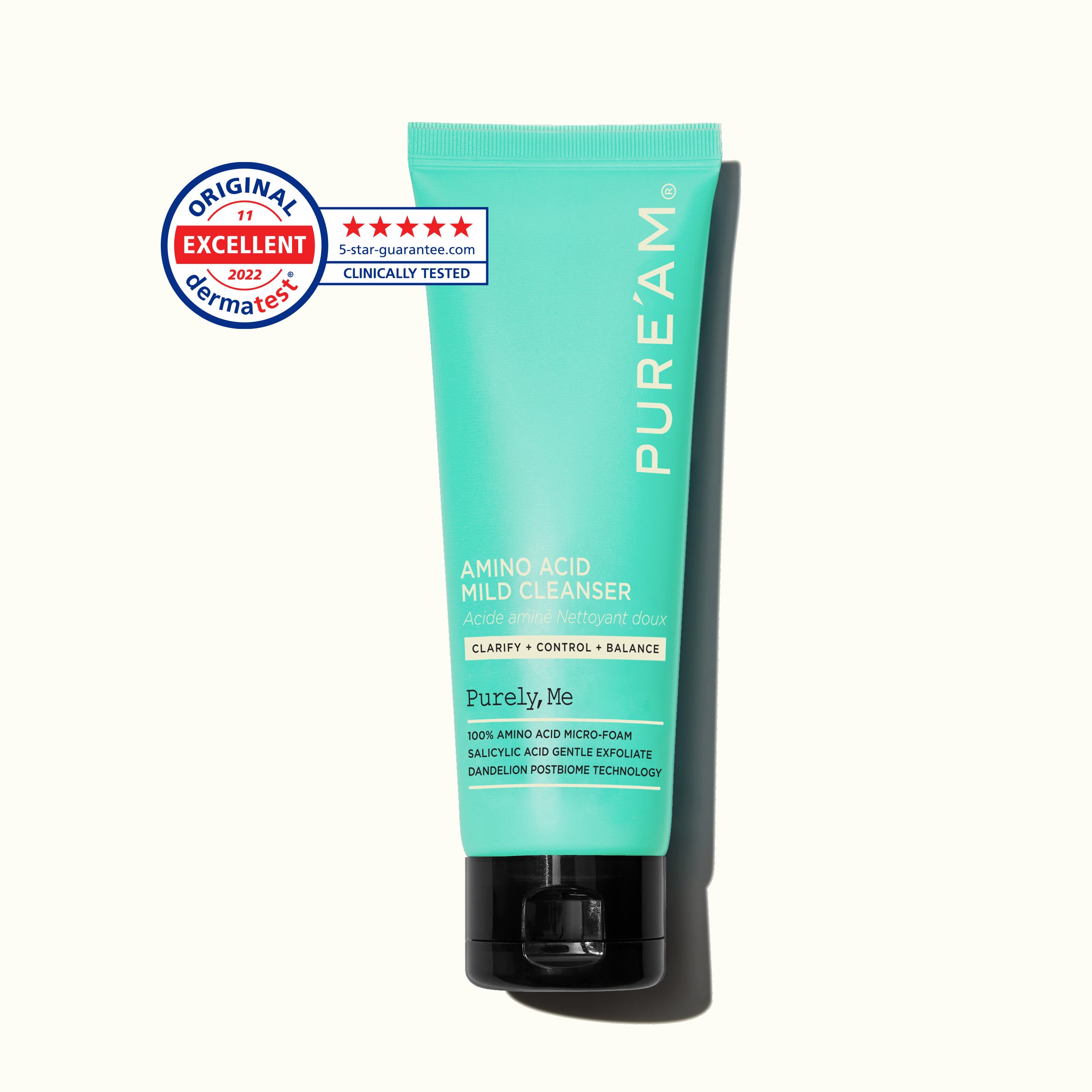
At PURE'AM, we don't use "organic" as shorthand for "gentle." When a product page names a certified ingredient, we try to specify which certification and what it actually covers, alongside the role that ingredient plays inside the full formula. The AMINO ACID MILD CLEANSER product page, for example, is written around the cleansing role the formula performs and the ingredients that carry out that role, rather than resting on a single certified extract to make the case.
The read-through for any brand's product, including ours, stays the same: check what's behind the word "organic" before deciding it answers the question you actually have. For the certification-versus-skin-safety distinction in more detail, see Organic Certified? 3 Questions It Never Answers; for how a brand explains its whole formula beyond a single hero ingredient, see Which Sensitive-Skin Brands Explain Their Whole Formula?.
FAQ
If a product has a COSMOS logo, is the whole thing organic?
It depends on the signature next to the logo. COSMOS ORGANIC on a finished product means it passed the product-level organic thresholds. COSMOS APPROVED or COSMOS CERTIFIED refers to a single ingredient, and only tells you that ingredient was certified, not that the finished product was reviewed as a whole.
What's the actual difference between "natural" and "organic" cosmetics under COSMOS?
COSMOS NATURAL has no minimum organic-content requirement; it only requires ingredients to meet natural-origin and processing rules. COSMOS ORGANIC adds a specific organic-content floor on top of those same rules: at least 20% of the total formula for leave-on products, or 10% for rinse-off products, with 95% of the processed plant-based ingredients organic.
Does a 10% organic figure mean the brand didn't try very hard?
Not necessarily. Water can't be certified organic and it makes up a large share of most skincare formulas, so the organic percentage is calculated against a formula that's often mostly water. A formula that's substantially organic in its non-water portion can still show a modest headline number once water is factored back in.
Is an "ISO 16128 natural index" score the same as a certification?
No. ISO 16128 is a calculation method for estimating natural or organic content indices, and a brand can apply that calculation on its own without a third party auditing the finished product. That makes an ISO 16128 figure a different level of verification than a COSMOS product signature, which does involve independent review.
Does organic certification mean a product won't irritate sensitive skin?
No. Organic certification reviews how ingredients are farmed and processed; irritation risk comes down to the finished formula's surfactants, preservatives, and fragrance load instead. Plant-derived fragrance components are a common source of irritation and are specifically called out for allergen labeling in the EU and Korea, regardless of whether the product carries an organic certification.