If your skin feels tight before you even reach for your serum, the problem may begin with the first step of your routine.
Cleansing does more than remove sunscreen, oil, and daily buildup. The surfactants in a cleanser—and how the formula interacts with the skin’s naturally acidic surface—can influence how comfortable your skin feels after rinsing. Dermatology reviews have long noted that harsher surfactants may disturb skin proteins and lipids, while milder liquid cleansers and synthetic detergent systems tend to cause less barrier disruption and smaller changes in skin pH (Ananthapadmanabhan et al., 2004; Draelos, 2003). A later review likewise distinguishes alkaline soaps from less barrier-disruptive synthetic detergent cleansers and emphasizes that cleanser mildness depends on formulation, not marketing language alone (Mukhopadhyay, 2011).
That does not mean one exact pH number guarantees a gentle cleanser. It means the entire formula matters: the surfactant system, contact time, water temperature, frequency of cleansing, and the condition of your skin all work together.
Why does skin feel tight after cleansing?
That squeaky-clean sensation can feel satisfying, but for dry or sensitive skin it may also signal that cleansing has removed more than you intended. A cleanser that leaves skin uncomfortable can make the rest of a routine feel like damage control.
A more useful question is not “Did this cleanser foam enough?” but:
- Does my skin feel comfortable after rinsing?
- Can I cleanse without immediate tightness or stinging?
- Is the formula appropriate for my skin’s oiliness and sensitivity?
- Am I using lukewarm—not hot—water and avoiding prolonged rubbing?
For reactive skin, a gentle cleansing step creates a calmer starting point for the hydration and moisture steps that follow.
What makes an amino acid cleanser different?
Amino acid–based surfactants are cleansing agents derived from amino acids and fatty acids. They can produce a fine foam while offering an alternative to harsher cleansing systems. “Amino acid cleanser,” however, is not a universal guarantee: concentration, supporting ingredients, and the complete formula still determine how a product behaves on skin.
PURE'AM AMINO ACID MILD CLEANSER uses four amino acid–based cleansing agents: Sodium Cocoyl Glycinate, Sodium Cocoyl Glutamate, Sodium Methyl Cocoyl Taurate, and Sodium Cocoyl Apple Amino Acids. The formula also contains glycerin and less than 0.5% salicylic acid, according to the official product page.
The cleanser is positioned for oily, combination, sensitive, and blemish-prone skin. Because it includes salicylic acid, more is not necessarily better. Start with a small amount, massage gently, rinse with lukewarm water, and pay attention to how your own skin responds—especially if you already use exfoliating acids or retinoids elsewhere in your routine.
Does a pH-balancing toner make serum work better?
Not in the simple, absolute sense often suggested online. A toner cannot guarantee that another product will “work,” and a serum’s performance depends on its own formulation and how it is used.
What a well-chosen toner can do is make the transition from cleansing to treatment more comfortable. After rinsing, a hydrating toner can add water-binding ingredients and emollient or barrier-supporting components before serum or moisturizer.
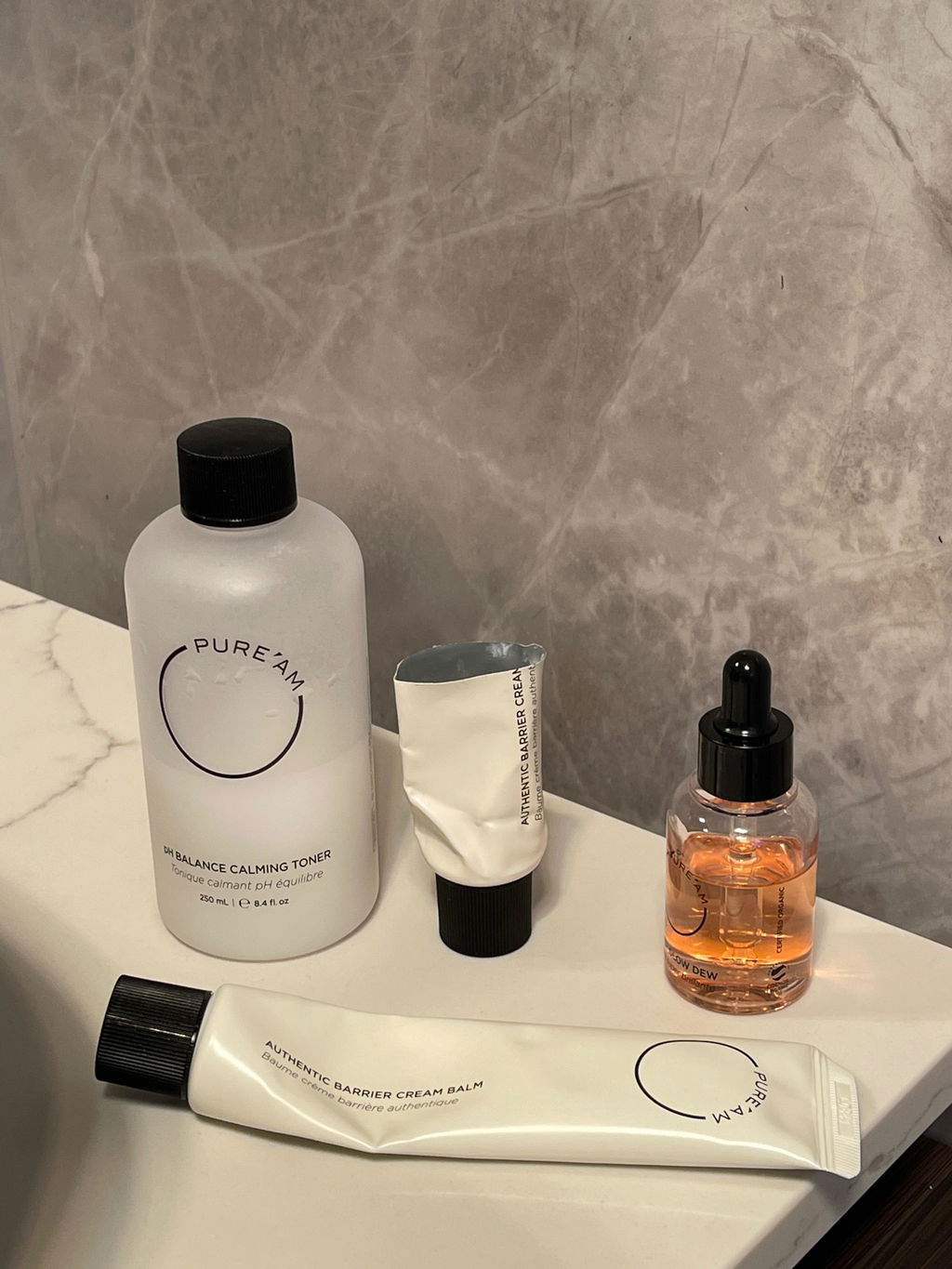
PURE'AM pH BALANCE CALMING TONER contains Ceramide NP, three forms of hyaluronic acid, glycerin, betaine, polyglutamic acid, squalane, and botanical extracts including Centella asiatica. Its certified-organic claim is specifically listed as 10% organic and 100% natural ingredients, with CUK registration number CU856114—not as a claim that every ingredient is organically certified. Full details are available on the official toner page.
This is the more accurate idea behind “pH continuity”: each step should avoid creating a new problem that the next step has to correct.
A simple cleanser-to-serum routine for sensitive skin
1. Cleanse without chasing squeaky-clean skin
Use a small amount of cleanser with water. Massage gently over the face and neck, rinse thoroughly with lukewarm water, and pat dry. If your skin feels persistently tight, reconsider your cleansing frequency, technique, or formula.
2. Replenish hydration while skin is comfortable
Shake the pH BALANCE CALMING TONER, pour it into your palms, and gently press it onto cleansed skin. One light layer may be enough; dry skin may prefer an additional thin layer.
3. Add only the treatment your skin needs
Apply your chosen serum according to its directions. Introduce strong active ingredients gradually rather than layering several new products at once. If sensitivity appears, simplify the routine so you can identify the cause.
4. Seal in moisture
Finish with a moisturizer suited to your skin. In the morning, use broad-spectrum sunscreen as the final skincare step.
How to judge whether the routine is working
A good routine does not need to feel dramatic. Over time, look for practical signals:
- Less tightness immediately after cleansing
- Fewer episodes of stinging when applying leave-on products
- Comfortable hydration without excessive layering
- A routine simple enough to use consistently
If burning, swelling, persistent redness, or worsening breakouts occur, stop the suspected product and seek advice from a qualified medical professional.
The takeaway
Your cleanser does not single-handedly determine whether your serum succeeds. But it does set the conditions for everything that follows.
For sensitive skin, the goal is continuity rather than correction: cleanse without unnecessary stripping, restore hydration, add a targeted treatment only when needed, and finish with moisture protection. PURE'AM’s AMINO ACID MILD CLEANSER and pH BALANCE CALMING TONER are designed to function as the first two steps of that calm, barrier-conscious routine—without asking one product to make promises it cannot prove.