A liposome ceramide toner uses lipid-membrane carriers to hold ceramides within its formula. We recommend treating liposome encapsulation as a formulation detail, not a guarantee of deeper penetration or longer-lasting hydration. For sensitive skin, consider ceramides’ role in the skin barrier alongside the complete formula, texture, and evidence for the finished toner, rather than choosing by the technology name alone.
How does it differ from a conventional ceramide toner?
Ceramide is an ingredient name. Liposome encapsulation describes a way of incorporating that ingredient into a formula. Think of a liposome as a small vesicle with a lipid membrane, but do not assume that encapsulation always places an ingredient in its watery center.
Hümeyra Şahin Bektay, affiliated with Istanbul University’s Faculty of Pharmacy, and colleagues describe ceramide NP’s low water solubility as a formulation challenge in their ceramide NP liposome study published in Pharmaceutics. Liposomes are among the carriers researchers investigate when developing formulas for poorly water-soluble ingredients. The researchers also explain that ceramide NP may sit within the liposome’s lipid membrane rather than its aqueous interior.
The distinction is not that ceramide becomes a better ingredient. It is that a structure has been designed to carry it.
A toner without the word “liposome” on its label should not automatically be judged as having poorly dispersed ceramides or weaker moisturizing performance. Each product’s formulation and supporting evidence need to be considered individually.
Why look at both the ingredient and the formula?
Interest in ceramides starts with their relationship to the skin barrier. In the background to the same Pharmaceutics paper, Bektay and colleagues describe ceramides, fatty acids, and cholesterol as lipids that make up the stratum corneum barrier. Ceramides are an important part of understanding the skin’s lipid structure.
For sensitive, easily dehydrated skin, we encourage a broader set of questions than simply “Does it contain ceramides?”
- How are the ceramides incorporated into the formula?
- What other moisturizing ingredients are included?
- Has the finished product been evaluated for the benefit I want?
Liposomes offer a clue about formulation. Neither the ingredient name nor an encapsulation claim alone tells you how comfortable a toner will feel on your skin. The complete formula and your experience of its texture remain part of the decision.
Does encapsulation mean deeper penetration or longer hydration?
A technology’s rationale and a finished product’s effects are different questions.
Bektay and colleagues’ ceramide NP liposome study evaluated particle characteristics, encapsulation, in vitro release, and cytotoxicity in cultured keratinocytes, among other laboratory measures. In their conclusion, the researchers state that further skin penetration and clinical efficacy data are needed to confirm efficacy.
Those findings do not establish a consumer toner’s penetration depth, hydration duration, or freedom from irritation on sensitive skin. Measuring how an ingredient is released in a laboratory is not the same as measuring how long a person’s skin stays hydrated after applying a toner.
When comparing products, match the evidence to the claim:
| Product claim | What to look for |
|---|---|
| Liposome-encapsulated | An explanation of which ingredient is carried and what type of carrier is used. |
| Deeper penetration | Evidence showing what was delivered, how far into the skin, and in which formulation. |
| Longer-lasting hydration | Measurements of a relevant hydration outcome in people using the finished product, including when it was measured. |
| Better than another toner | The actual comparison product and the conditions under which both products were used. |
Ingredient and carrier research can help explain formulation choices. It does not, by itself, establish that a particular toner outperforms another.
What is in our pH BALANCE CALMING TONER?
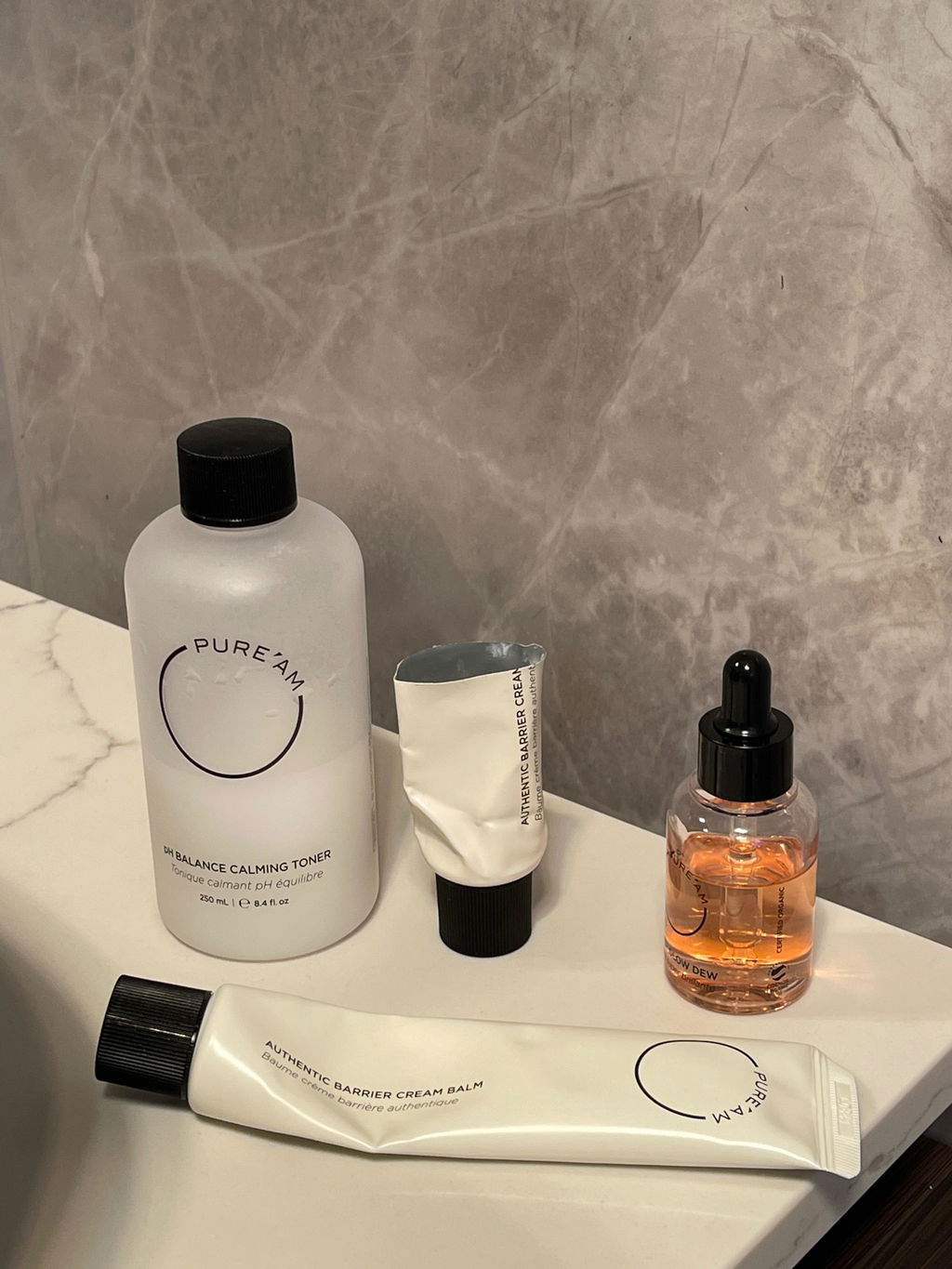
We describe PURE'AM pH BALANCE CALMING TONER as a liquid formula containing liposome-encapsulated vegan ceramide. It has a milky essence-toner texture and is presented as moisturizing care for dry, dehydrated, and sensitive skin.
To understand the formula, look beyond ceramide alone. Our full ingredient list and featured ingredient descriptions provide the following details:
| Ingredient | How to read it in the formula |
|---|---|
| Ceramide NP | An ingredient to consider alongside our description of the toner’s ceramide-based moisturizing design. |
| Glycerin | We describe its role in providing hydration and helping prevent moisture loss. |
| Sodium hyaluronate, hydrolyzed hyaluronic acid, and hyaluronic acid | Part of the formula’s hyaluronic acid-based moisturizing composition. |
| Hydrogenated lecithin | Listed in the formula. Its presence alone does not establish the finished product’s liposome particle size or encapsulation efficiency. |
This approach brings the ceramide, accompanying moisturizing ingredients, and milky liquid texture into the same picture. The laboratory liposome research discussed above should not be read as clinical results for our toner.
How should you read the organic ingredient labeling?
Organic labeling and liposome encapsulation answer different questions.
Our toner’s ingredient list uses an asterisk to identify certified organic ingredients. Yuzu fruit water, glycerin, aloe leaf extract, and green tea extract are among the marked ingredients. Ceramide NP does not carry that same asterisk.
Rather than extending “organic” to every ingredient in a product description, check which ingredients are marked. If certification is a purchase criterion, also distinguish the certifying organization, the standard, and whether certification applies to an ingredient or the finished product.
Organic labeling concerns the scope of certification. Liposomes concern formulation design. Hydration and penetration claims concern evidence for the relevant product. The use of organic ingredients should not be treated as proof of non-irritation or superior penetration.
How does a milky toner fit into your routine?
If you want a milky liquid moisturizing step, start with the encapsulation explanation, the complete formula, and finished-product evidence relevant to the benefit you expect. We do not consider toner a mandatory step for everyone. Choose according to the moisturizing steps you want and the textures you prefer.
Our pH BALANCE CALMING TONER directions are to shake the bottle after cleansing, dispense into your palms, and gently pat onto the skin to absorb. Follow with a moisturizing cream. This sequence does not mean the toner replaces every other moisturizing step.
Explore our toner’s full ingredient list and directions to decide whether its milky texture and formula fit your routine. Let the step you need and the formulation details guide your choice, rather than the technology name alone.